


4 Questions a Company Executive Should Clarify When Choosing a Partner for Installing an Electroplating Line
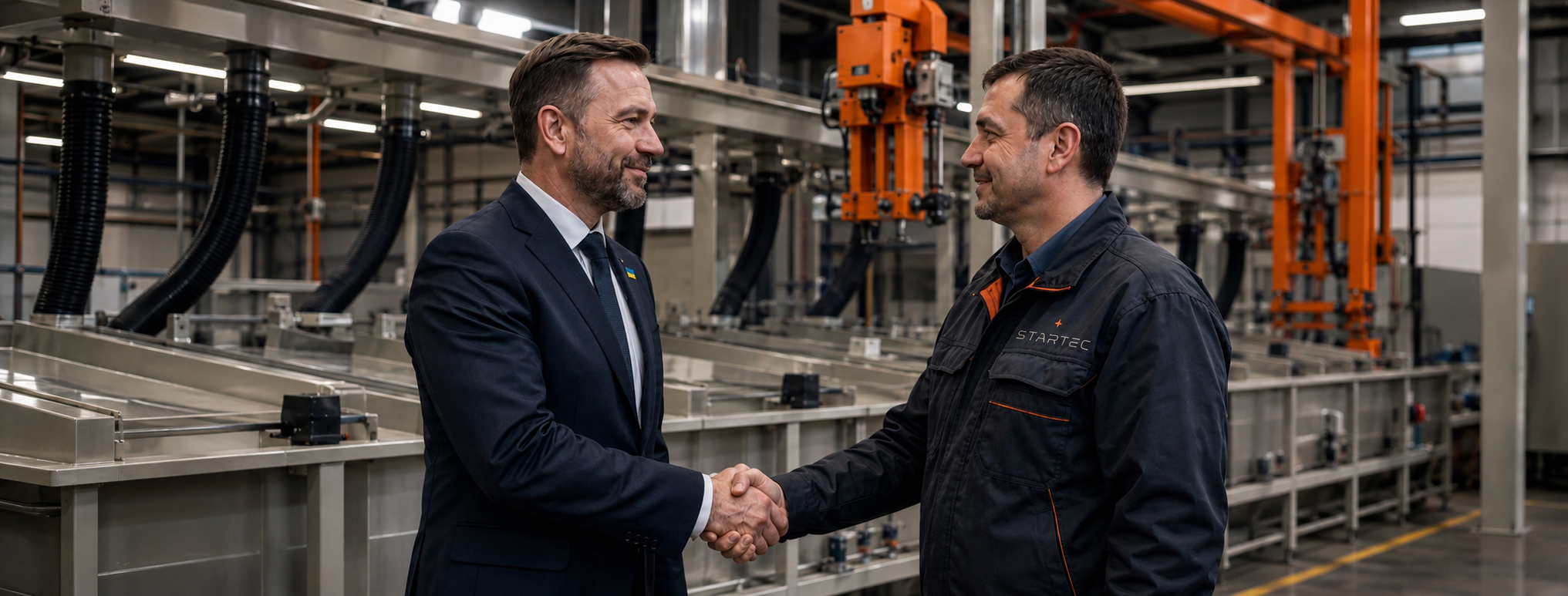
Choosing a contractor for the installation or modernization of an electroplating line is a decision that should not be evaluated only by the tender offer and the cost estimate. On paper, two proposals may look similar: tanks, automatic transporter, control system, installation, commissioning, warranty and service. But in real production, the difference becomes clear in practice, almost immediately after the cooperation agreement is signed – when it is necessary to test sample parts, achieve stable and repeatable coating quality, maintain the planned productivity, ensure wastewater treatment, train personnel and receive fast professional support in case of any deviation in the line operation.
A well-considered decision when choosing a contractor affects not only the economics of production, but also your company’s reputation in the eyes of the final customers of your products.
This is especially important for companies working for the defense sector, including those involved in government contracts. In such production, electroplating is not a decorative stage. It is protection of the part against corrosion, stability during storage, reliable performance in aggressive environments, increased service life of the product and predictable behavior under load.
Question 1. Can the potential partner ensure the required coating quality for our product on an industrial scale? And is the partner ready to be responsible not only for the supplied equipment, but also for the technological result?
The most common mistake is to think that the main things in an electroplating line are its dimensions, price or manufacturing time. For a company, the key question is different: will this line be able to consistently provide the required coating quality specifically for your parts, in your volumes, in your production mode and in accordance with the requirements for further use of the product?
In industrial electroplating, quality cannot always be assessed visually. A product may look correct after coating, but this does not yet mean that it will pass the required tests. Coating thickness, hardness, adhesion, durability, repeatability of the result and the way the coating behaves under load are all important. Chemical surface preparation of the product is also critically important. If it is performed incorrectly, the coating may fail to adhere properly, peel off, fail to provide the required service life or fail to meet the technical requirements.
That is why at Startec Industries we do not start with the formal question of «what kind of line should be manufactured?», but with an understanding of the production result the customer needs to achieve. If the customer already has a proven technology, a clear technical specification and understands what line configuration is required, we design and manufacture the equipment according to these parameters. But if the customer has only a production task – for example, to ensure a certain type of coating for a specific part with a defined productivity – we help go through the path from clarifying the need to a solution that can be scaled into production.
In such projects, checking the technological logic before launching the industrial line is especially important. In certain cases, the Startec Industries team, together with technologists and chemists, works out the process on test samples: selects the chemical process, performs trial coating, sends the part to the customer for testing and only after the required quality is confirmed proceeds to designing or scaling the solution. This makes it possible to reduce technological risks even before the equipment manufacturing stage.
For large-scale production, one high-quality sample is only the beginning. The real task of an electroplating line is to repeat the required result thousands, hundreds of thousands or millions of times. That is why Startec Industries considers coating quality not as a separate stage, but as the main criterion of the entire line’s efficiency: it must provide the required productivity, process stability and predictable repeatability of the result on an industrial scale.
Question 2. Can the potential partner take responsibility for the entire scope of tasks: from preparing the technical specification and selecting the chemistry to proper service after commissioning?
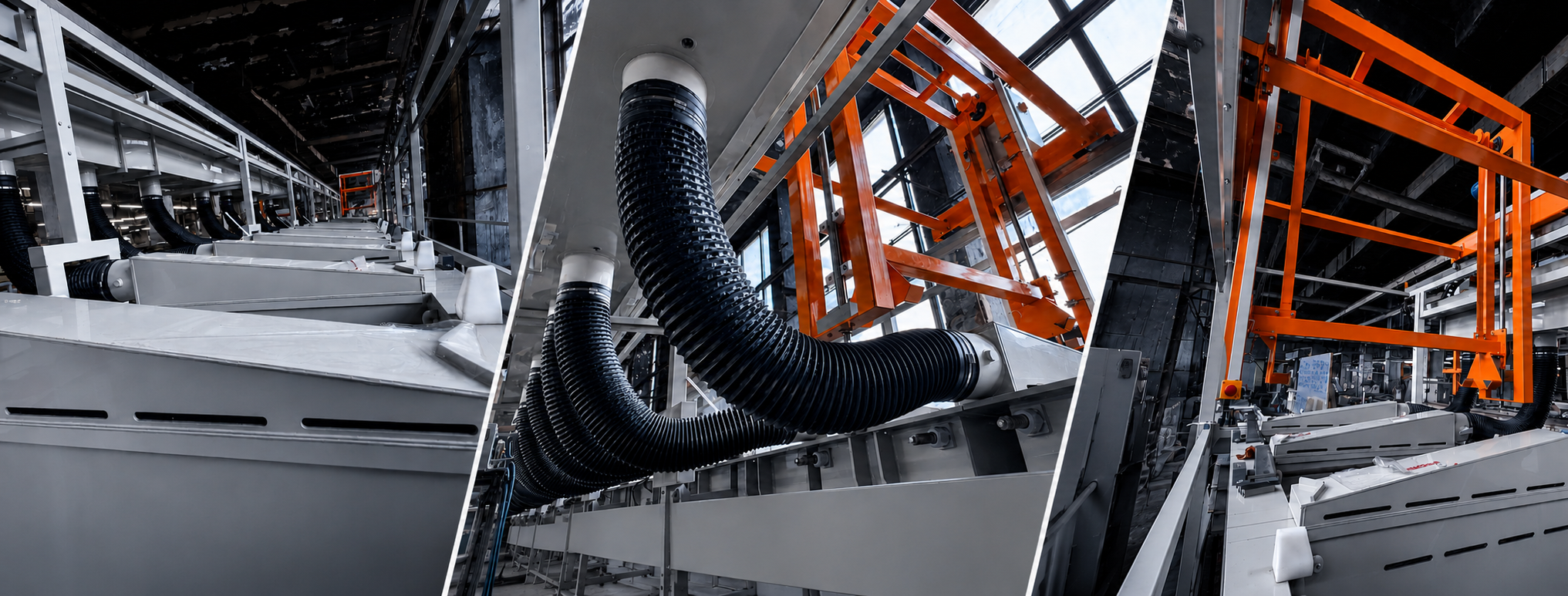
An electroplating line is a complex engineering system. It consists not only of tanks and a metal frame. It combines chemistry, mechanics, electronics, automation, ventilation, wastewater treatment, installation, personnel training and service. If one of these elements falls out of the project logic, the risk shifts to the customer.
At Startec Industries, the project of building an electroplating line for a customer is carried out as one consistent process.
First, the customer together with our project director forms and agrees on the technical specification. If the customer already has its own technology and clearly understands what process is needed, the Startec team develops the electroplating line design according to these requirements. If the customer has only a production task, our technologists and chemists join the work. They determine the sequence of processes, types of solutions, exposure time, temperature modes, surface preparation requirements and quality control requirements.
After that, the designers start their work. They transform the technology into a physical line: calculate the number and dimensions of the tanks, the frame structure, movement of the automatic transporter, location of units, loading logic, line dimensions and the possibility of installing it in a specific facility.
Then electronics engineers create the control system – in fact, the «brain» of the line. It must control all key stages of its operation: heating, movement, sensor signals, process parameters, operation of the waste neutralization system and other elements.
An important competitive advantage of Startec Industries is our own modular control system, developed by our electronics engineer for electroplating lines. Its advantage is that it is not created from scratch every time. It consists of modules that can be adapted to different tasks, configurations and types of lines. This makes the system more flexible, easier to maintain and faster to adapt to new projects.
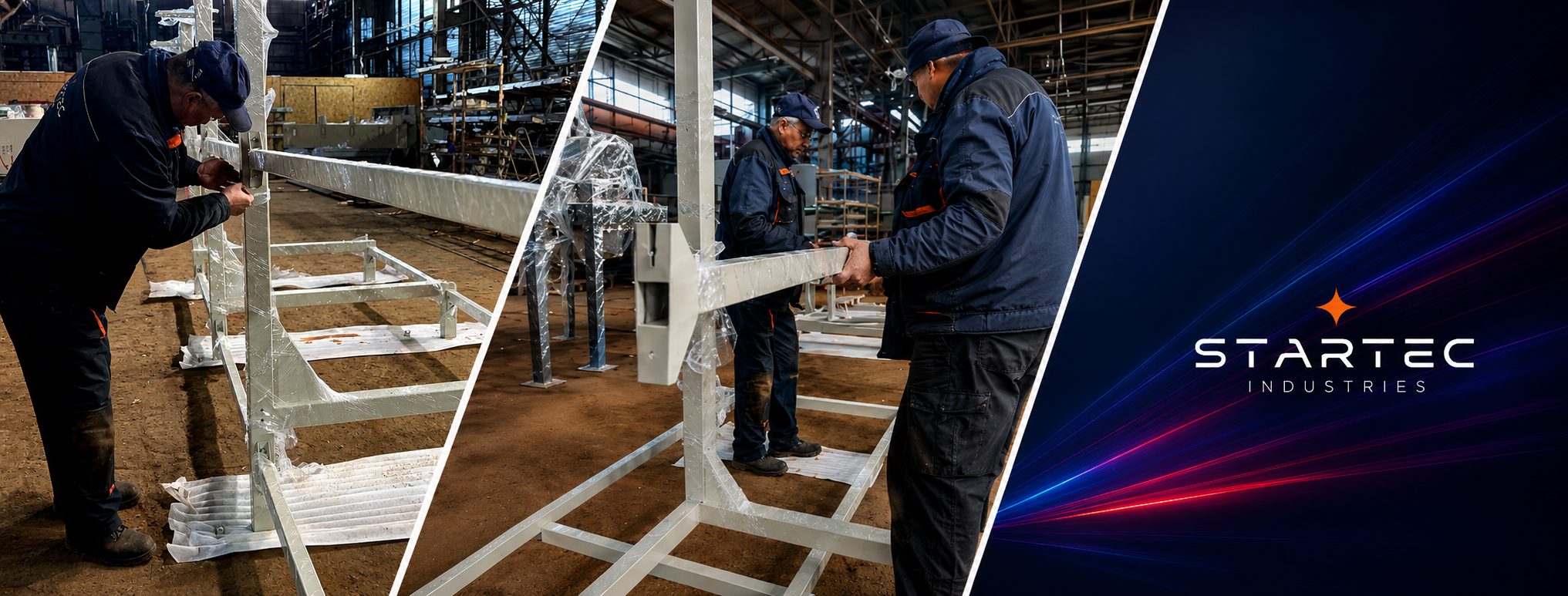
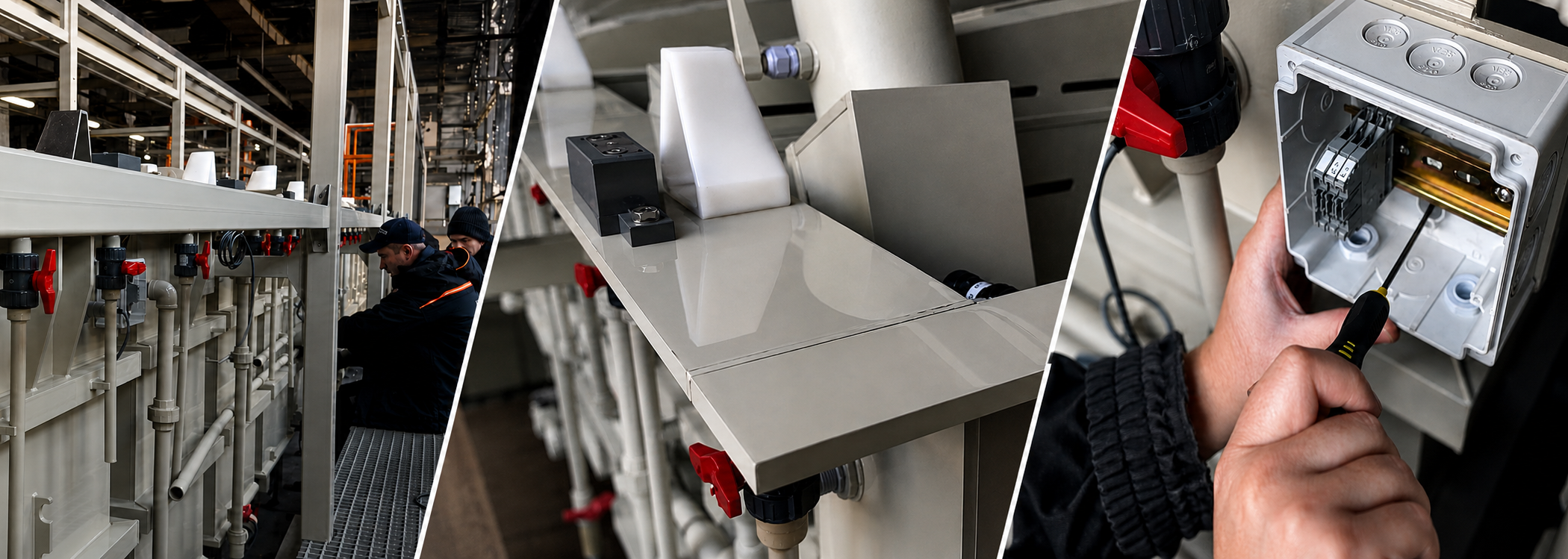
After the design stage, production begins. At Startec Industries’ own production site, metal structures, plastic tanks, units and line components are manufactured. Special attention is paid to working with plastic: high-quality welding of plastic elements requires proper conditions, temperature, qualified specialists and adherence to the technology.
For us, this is not a formality. LLC Startec Industries employs highly qualified and certified specialists in metal and plastic welding. The production facility has ISO certification, its own technical specifications and internal quality control standards. This clearly distinguishes us as a systematic manufacturer from a random contractor.
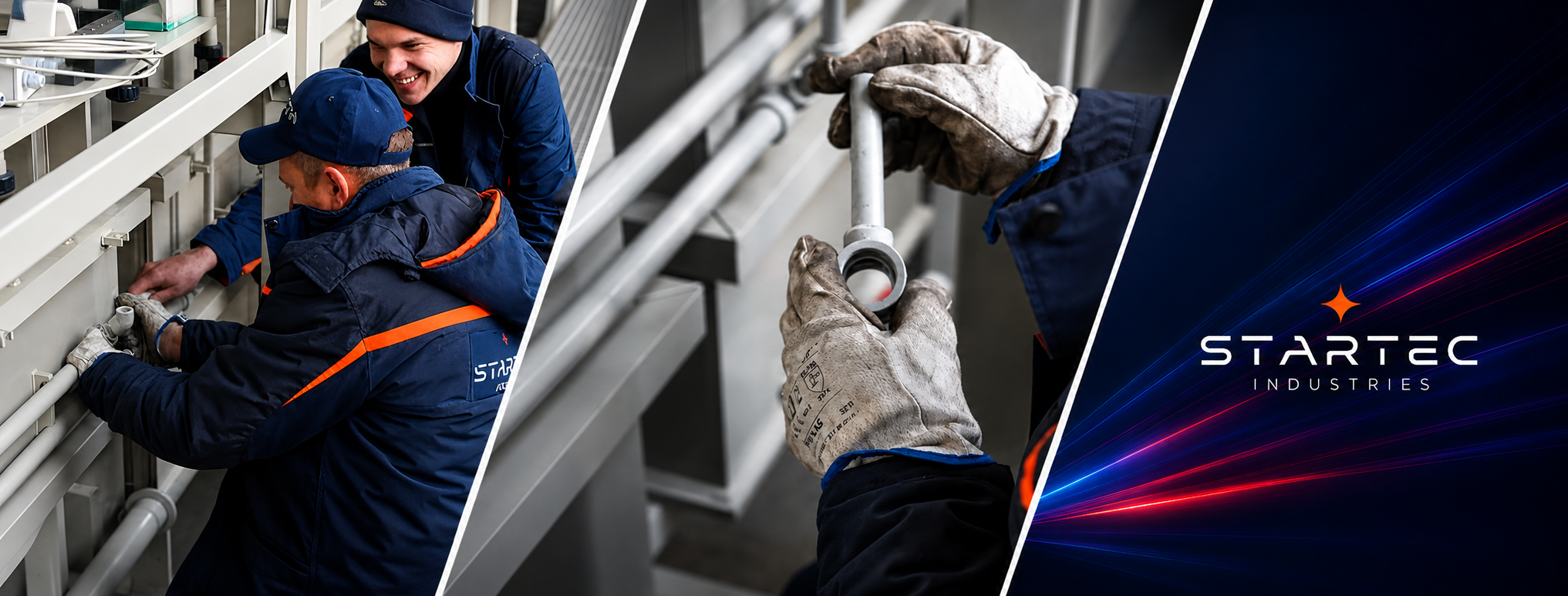
At the final stage, our service team is involved in the installation and commissioning of the line, and after the equipment is put into operation, it is responsible for further support.
A separate important area is the treatment of electroplating wastewater. For large industrial enterprises, this is not an additional option, but part of a responsible project. Electroplating involves working with chemical solutions, so spent liquids must be properly treated, separated and prepared for further disposal. In large projects, the treatment unit may account for a significant part of the budget, but it is this unit that ensures the environmental and technological correctness of production. A potential partner must consider the wastewater treatment system as part of one complete solution together with the line.
An electroplating line operates in an aggressive environment. Chemistry, vapors, loads and continuous operation – all of this quickly shows how well the equipment was designed, manufactured and installed.
For Startec Industries, quality is a principle embedded in every stage of work: from the first conversation between our project manager and the customer to line installation at the site and service support after commissioning.
Question 3. Will the partner be flexible and customer-oriented enough? Will the partner be there when our production needs not an explanation, but a quick solution to a standard or non-standard situation?
In real life, complex industrial projects rarely proceed in a perfectly linear way. Even if the technical specification has been agreed, new limitations may appear during the process. It may turn out that the line needs to be fitted into the premises differently. The loading logic of parts may change. The control system may need adjustment. There may be a need to modernize a separate unit or replace low-quality components supplied by subcontractors.
This is where the difference between a supplier and a partner becomes visible. A supplier usually works within the limits of the initial configuration. A partner participates in solving the task until the production facility receives the required result. Therefore, when choosing imported equipment or a supplier without a local engineering and production base, each such change often means complicated, long and expensive communication.
LLC Startec Industries is a local Ukrainian manufacturer with its own professional team and modern production facilities. This ensures greater flexibility at every stage of the project, faster communication, the ability to make changes quickly, refine the design, replace a unit, send a service team to the site after line commissioning, and resolve any issue before and after launch quickly and without unnecessary bureaucracy.
For enterprises working in the defense production sector, this is especially important. Delays in project implementation or equipment downtime after commissioning are not only technical problems. They create risks of missed deadlines, disrupted production schedules, financial penalties and reputational losses in front of the final customer. Therefore, the partner’s flexibility, speed of response and proper service support often carry the same weight as the quality of the equipment itself.
If our customer has a technical question, the Startec service team responds very quickly – regardless of whether it is a warranty case or a non-standard situation. In situations where something goes wrong, even if it is not our fault, Startec always resolves the issue in favor of the customer. In some cases, even at our own expense.
For us, this is not only a service policy. It is a matter of reputation. Startec Industries works for the long term. Many customers return to us with new orders or recommend the company to other enterprises. In industrial business, this is the strongest confirmation of trust.
Partner flexibility is also important in modernization projects. Many enterprises today operate outdated lines that were installed during the Soviet or post-Soviet technological era. Such lines are often physically worn out and no longer meet current production requirements.
LLC Startec Industries can not only build a new line from scratch, but also modernize the elements that determine process stability, safety and productivity: replace tanks, automatic transporters, control systems, exhaust units, drums and other components. After all, it is not always necessary to build a line from scratch. Sometimes, a competent modernization is the more effective solution.
Question 4. Can we entrust the long-term success of our project to this partner? What principles guide the partner’s work? What is the partner’s reputation in the market?
An electroplating line is not just an investment that must operate for years. It is not purchased impulsively. It is designed for a specific production logic, a specific product, a specific volume and specific quality requirements.
Every line is individual. There is no universal solution that can simply be «taken from the shelf» and installed at any enterprise.
That is why, for Startec Industries, the key word in working on complex customized projects is partnership. We do not treat such orders as one-time deliveries. We build long-term relationships with customers, where trust, responsibility, communication quality and readiness to be there after commissioning are important.
Denys Olofinskyi, CEO of Startec Holding, puts it simply: «We treat your project as our own».
This is not a nice phrase for a presentation. It is our business philosophy, which is reflected in our daily work: in our willingness to work through the technical specification and test samples even before the main contract is signed, in customer-oriented service, in our ability to respond quickly to customer requests, in internal quality control and in our desire to make every next project better than the previous one.
We take our reputation very seriously. In industrial business, reputation is not built on words and promises. It is built on years of expertise, successfully commissioned lines, repeat requests, recommendations and trust from companies for which a mistake is too costly.
Today, companies contact Startec Industries regarding the construction of electroplating lines not only when we already have previous experience of cooperation with them, for example in the field of metalworking equipment installation. A significant part of new contacts comes through recommendations from our current partners. For us, this is the most important indicator of trust: when an enterprise is ready to recommend us to another manufacturer, it means that the cooperation was not only correct, but also effective, responsible and professional.
It is especially valuable for us that Startec Industries’ positive reputation is also confirmed during checks by new customers from strategic industries. In such projects, companies carefully evaluate the previous experience of a potential contractor, collect feedback, clarify the quality of completed work and assess the level of service support. That is why we treat every project as a partnership for years: we look for solutions, take full responsibility, respond quickly to any situations and do everything in our power to make sure our customer remains satisfied.
We are confident that in the complex industrial B2B market, in the long run, the winner is not the one who simply wins the tender and installs the line. The winner is the one who helps the customer’s enterprise achieve the result: the required quality, the required productivity, process stability and confidence that there is not just a contractor nearby, but a partner who understands the cost of responsibility.


